
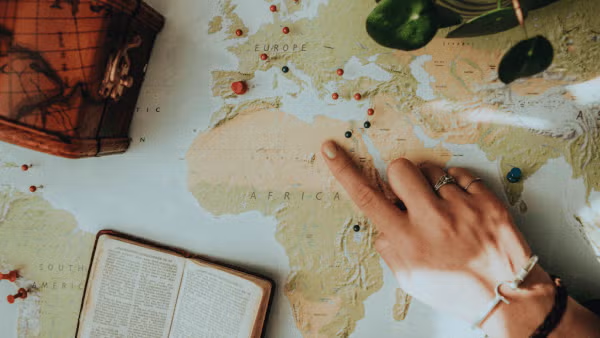
In a world where smartphones, GPS navigation, and travel applications have become essential companions, travelling with a traditional paper map might seem like an old-fashioned idea. However, paper maps offer something that digital navigation cannot always provide: a sense of adventure, independence, and a deeper connection with the places you visit.
Whether you are exploring a historic European city, driving through the Egyptian desert, hiking in the mountains, or discovering remote villages, knowing how to use a paper map can make your journey more rewarding and sometimes even safer.
So, before your next adventure, consider putting your phone aside for a moment and learning how to travel with a paper map.
1. Choose the Right Map for Your Journey
Not all maps serve the same purpose. Before travelling, choose a map that matches your destination and activities.
Here are some common types:
- Road maps: Ideal for road trips, showing highways, secondary roads, towns, and distances.
- City maps: Useful for exploring streets, landmarks, museums, restaurants, and public transportation.
- Topographic maps: Essential for hiking and outdoor adventures because they show elevation, mountains, valleys, and natural features.
- Tourist maps: Designed to highlight attractions, historical sites, visitor facilities, and popular routes.
- Regional maps: Useful when travelling between cities or exploring several destinations.
Choose a map with clear labels, a useful scale, and sufficient detail for your intended journey.
2. Learn How to Read a Map
Understanding a few basic map elements will help you navigate confidently.
The legend: Explains the symbols used on the map, such as roads, rivers, airports, hotels, and tourist attractions.
The scale: Shows the relationship between distances on the map and actual distances on the ground. For example, a scale of 1:100,000 means that one centimetre on the map represents one kilometre in reality.
The compass rose: Indicates the cardinal directions: North, South, East, and West.
Grid references: Help you identify specific locations using numbered or lettered coordinates.
Contour lines: On topographic maps, these lines indicate changes in elevation and help you understand the shape of the landscape.
Once you understand these elements, a paper map becomes a practical navigation tool rather than simply a printed picture.
3. Identify Your Starting Point and Destination
Before beginning your journey, locate your current position and the place you want to reach.
Look for recognizable landmarks, such as:
- Major roads and intersections.
- Rivers, lakes, and coastlines.
- Mountains and hills.
- Railway stations and airports.
- Towns, villages, and important buildings.
Mark your starting point and destination using a pencil or removable marker. This will help you visualize the journey before setting off.
4. Plan Your Route Before Travelling
One of the greatest advantages of using a paper map is the opportunity to plan your journey in advance.
Instead of simply following a digital navigation instruction, you can study the entire route and understand how different locations connect.
Consider the following:
- Identify the main route and alternative roads.
- Estimate the distance between destinations.
- Locate fuel stations and rest areas.
- Identify interesting attractions along the way.
- Check for mountain passes, difficult terrain, or restricted areas.
- Allow additional time for unexpected delays.
For longer journeys, divide your route into smaller sections and identify convenient stopping points.
5. Learn How to Orient Your Map
Orienting a map means aligning it with the actual direction of the surrounding landscape.
A simple method is to use a compass:
- Place your map on a flat surface.
- Identify the north direction on the map.
- Use your compass to find magnetic north.
- Rotate the map until its north direction aligns with the compass.
- Compare the surrounding roads, mountains, and landmarks with the map.
Once correctly oriented, the map becomes easier to understand because its directions correspond more closely to the landscape around you.
Remember that a magnetic compass may require magnetic declination adjustment for accurate navigation, particularly when travelling long distances or hiking in remote areas.
6. Use Landmarks to Stay on Track
You do not need to check your map every few minutes. Instead, identify major landmarks along your route.
For example, when travelling through a city, you might use a famous square, a museum, or a railway station as a reference point.
When exploring natural landscapes, mountains, rivers, valleys, and distinctive rock formations can help you understand your position.
The key is to compare what you see around you with what appears on your map.
7. Carry a Compass and Essential Navigation Tools
A paper map becomes even more useful when combined with a few basic tools.
Consider carrying:
- A reliable magnetic compass.
- A pencil and eraser.
- A small ruler.
- A protective waterproof map case.
- A notebook for recording directions.
- A flashlight for low-light conditions.
If you are hiking or travelling through remote areas, carry an appropriate topographic map and learn how to use it before departure.
8. What to Do If You Get Lost
Getting lost is not necessarily a disaster, but remaining calm and making sensible decisions is essential.
Follow these steps:
- Stop walking or driving in an unfamiliar direction.
- Look around for recognizable landmarks.
- Check your last known position on the map.
- Identify nearby roads, rivers, or settlements.
- Retrace your route if it is safe to do so.
- Ask a reliable local person for directions when appropriate.
If you are hiking in remote terrain, avoid continuing blindly or taking shortcuts through unfamiliar areas. Follow established safety procedures and contact emergency services when necessary.
A paper map should be part of a broader navigation and safety plan, not your only protection.
9. Protect Your Map During the Journey
Paper maps can be damaged by rain, sunlight, dust, and repeated folding.
To keep yours in good condition:
- Use a waterproof map case.
- Avoid leaving it exposed to direct sunlight for long periods.
- Fold it carefully after use.
- Keep it away from food and liquids.
- Store it in an easily accessible location.
- Carry a backup copy for important journeys.
For extended outdoor adventures, consider using a waterproof or tear-resistant map.
10. Why Travelling with a Paper Map Is Still Worthwhile
Despite advances in technology, paper maps continue to offer several advantages.
No battery required: You can use a paper map without worrying about charging your phone.
No internet connection needed: It works in remote locations where mobile networks may be unavailable.
A broader perspective: Unlike many phone screens, a large paper map allows you to see entire regions and understand the geographical relationship between destinations.
Better trip planning: Studying a map encourages you to think about distances, alternative routes, and interesting places along the way.
A more adventurous experience: Navigating with a map can make discovering unfamiliar places more engaging and memorable.
11. Paper Maps and Digital Navigation: Why Not Use Both?
Using a paper map does not mean abandoning modern technology.
In fact, combining traditional and digital navigation is often the smartest approach.
Use your smartphone or GPS to check current traffic conditions, road closures, and precise locations. Keep your paper map as a backup and use it to understand the broader geographical area.
For hiking, remote travel, or desert adventures, always carry suitable navigation equipment and tell someone about your planned route.
Final Thoughts: Let the Journey Become an Adventure
Travelling is not always about reaching a destination as quickly as possible. Sometimes, the most memorable experiences happen when you take a different road, discover a small village, stop at an unexpected viewpoint, or explore a place that was never part of your original itinerary.
A paper map encourages you to look beyond the screen, observe your surroundings, and become an active participant in your journey.
So, on your next holiday or road trip, pack a traditional map alongside your smartphone. You might discover that getting to know the world is even more enjoyable when you take the time to find your own way.
SharmStan – Explore More. Experience More.